Brazil Side of Iguazu Falls: Tickets, Hours & How to Visit
Disclosure: Tess the Traveler contains affiliate links and is a member of the Amazon Associates Program, meaning that if you make a purchase using one of these links, I may earn a commission. I only recommend products and companies I trust. See the Privacy Policy for more information. Thanks for your support!
If you’re looking for big panoramic views, plus a walkway that leads right up to the towering Devil’s Throat waterfalls, then the Brazil side of Iguazu Falls is where you need to go.
Compared to the Argentina section of the falls, the Brazil side is the easiest side to visit on your own, with just one path and two to three hours to spare.
I spent a day exploring each side of the falls during a three-week solo trip through Brazil, and with around 275 separate waterfalls, this incredible destination is the largest waterfall system in the world. It’s one of the new seven natural wonders of the world as well as an UNESCO World Heritage Site — and I can promise you that it really lived up to its titles and more.
Each side offers something totally different, and both are more than worth exploring, but in this guide, we’ll just break down everything you need to know about visiting the Brazil side of Iguazu Falls, from how to get there, what to see, and where to stay. (Looking for a quick overview of both sides? I recommend starting with this guide.)


☀️My Quick Iguazu Falls Planning Tips🌈
🌎 My go-to travel insurance for Brazil and Argentina
🚣♀️ Book this bucket list-worthy boat ride under the falls
🌴 The dreamiest hotel stay on the Brazil side, Sanma Hotel,
🦥 A gorgeous treehouse lodge on the Argentina side, La Aldea de la Selva Lodge
🧳 At the top of my packing list: Sneakers, sunscreen, and a camera protector
📱 My favorite eSIM (Use code TESS10 for 10% off!)
What to see in Iguazu Falls, Brazil side
There’s a famous quote from Eleanor Roosevelt when she visited Iguazu. “Poor Niagara.” No offense to Niagara Falls, but I think she was right on this one.
The Brazil side was the first side I visited, and it really did feel magical.
Unlike the larger Argentinian side, the Brazil side just has one path that you can easily follow.
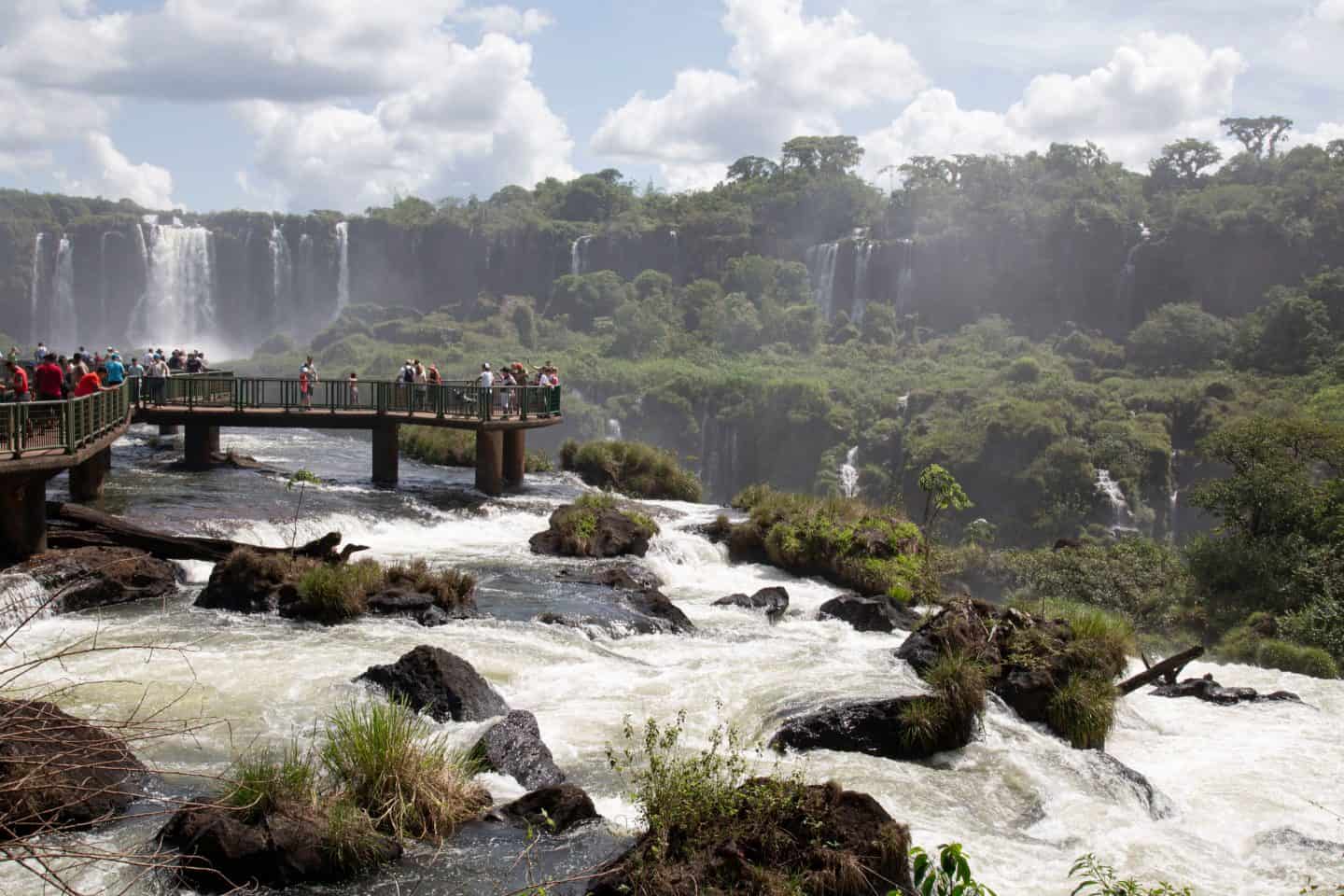
Even though it’s not huge, I would still plan to give yourself two to three hours to slowly walk around, enjoy the incredible views, and take lots of photos! The trail is overall about a mile-long, and throughout, you’ll reach a number of viewpoints with unreal views.
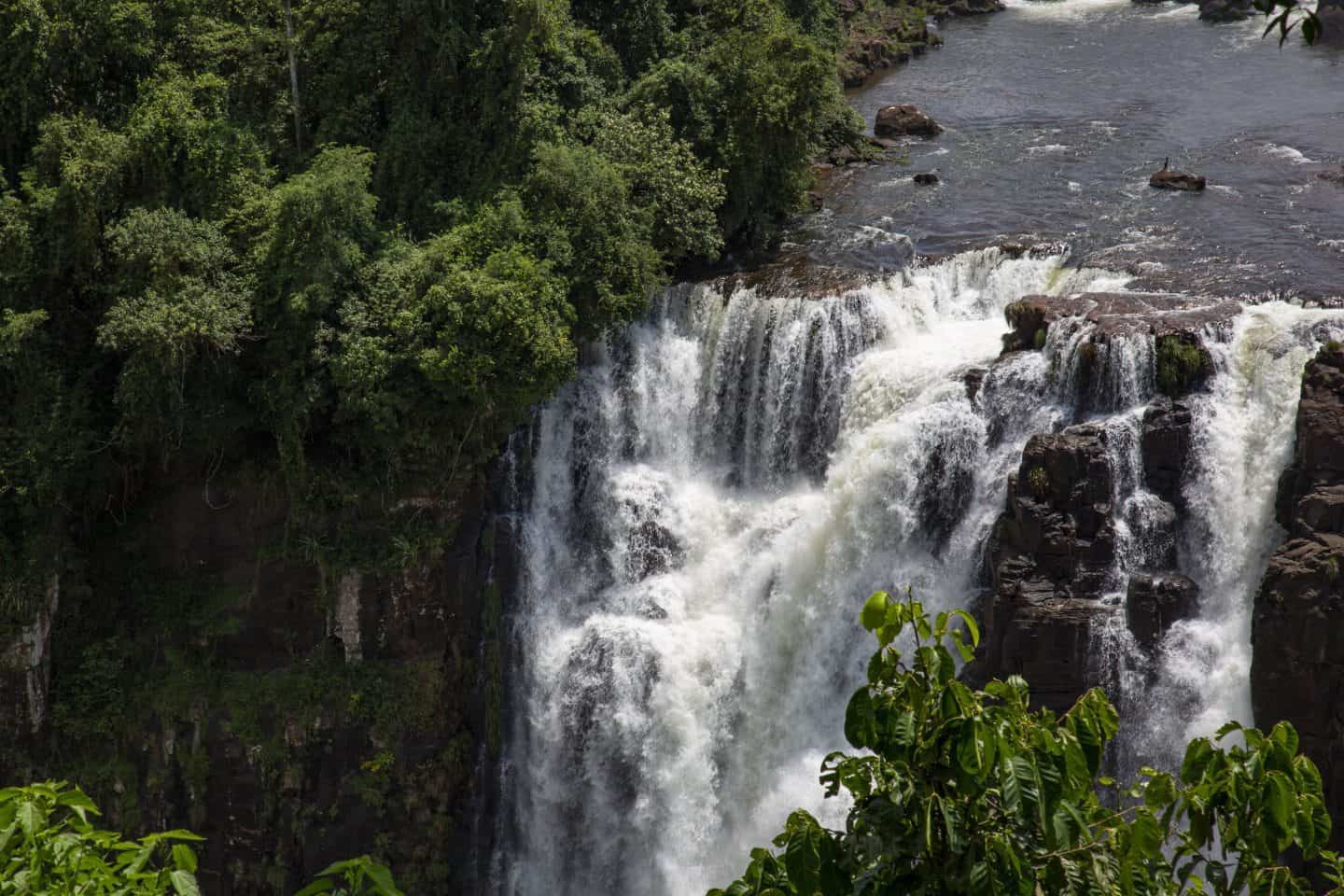
The highlight is undoubtedly Devil’s Throat (Garganta do Diabo), which you can access by a footbridge. It’s a horseshoe-shaped waterfall that’s also the tallest in the whole park at 269 feet, and you’ll get a really jaw-dropping up-close, panoramic view here. (You can also see it from the Argentinian side, but at a different angle, by the way)
Apparently, there’s enough water flowing to, on average, fill 36 Olympic swimming pools in just one minute.
⛵ If you have time and are up for getting really up-close-and-personal with the falls, you can also go on the Macuco Boat Safari. I skipped this but I wish I didn’t — it looks like so much fun!
🚁 For a true bucket list experience, within the Brazil side of Iguazu Falls, you can also take a helicopter ride! This top-rated option includes a 10-minute ride over the falls, for a truly unforgettable view!

Park details
The national park is open from 9 a.m. until 6 p.m. with the last entry at 4:30 p.m.
Park entry is currently R$131 for foreigners, and you have the option to purchase your tickets online ahead of time or in-person at the entrance.
(If you’re planning to also visit the Argentinian side, you will need a separate ticket.)
Once you enter the park, there is a free shuttle you can take to the beginning of the trail, Trilha das Cataratas, which will be the second stop. The shuttle leaves every 20 to 30 minutes.
As far as food, the Brazilian park has two options: Porto Canoas Restaurant, which serves a buffet and can be found at the end of the trail. You can also find a couple snack bars throughout the park.
I didn’t buy any food at the park, but I did in the Argentina side, and I was underwhelmed, both when it came to price as well as the quality. But you are allowed to bring your own food to both sides!
There are also lockers if you need to store your things at any point!

How to get to Foz do Iguaçu
Iguazu Falls stretches across two countries: Argentina and Brazil.
The Brazilian side, Foz do Iguaçu, is in the Paraná state in the southwestern part of the country. The Argentinian side, in Puerto Iguazu, is in Argentina’s northeastern corner.
From elsewhere in Brazil
From most other major cities in Brazil, flying will be the easiest option, by far. Not only are they the fastest, but even if you’re visiting Brazil on a budget, domestic flights are pretty reasonable, in my opinion.
If you’re coming from Rio de Janeiro, you can take a direct flight from Galeão International Airport (GIG) into the airport on the Brazilian side, Foz do Iguaçu International Airport (IGU) (there’s also an airport on the Argentinian side, by the way).
Flights will be around 2 hours and 15 minutes, and you should be able to find a flight through LATAM, Gol, or Azul.
From Sao Paulo, you can fly from Guarulhos International Airport (GRU) (be careful — Sao Paulo has two major airports and the other one doesn’t offer direct flights to Foz) on a direct flight which takes about two hours.

How to get to the actual falls
🚨 Before you visit Brazil
If you’re coming from the US, Canada, or Australia, Brazil now requires you to have a 90-day tourist evisa.
From Foz do Iguaçu
The entrance to the Brazilian side of the falls is about 12 miles (20 kilometers) from the town, Foz do Iguaçu.
The most budget-friendly option is to take a bus from the Terminal Transporte Urbano (TTU) station right to the park entrance. It costs R$5 (less than $1 USD) and leaves every 30 minutes. It will be bus 120, and it should say “Parque Nacional/Aeroporto.”
This is what I did, and it was very easy — and that’s coming from someone who has a horrible sense of direction and who typically avoids public transportation when I’m alone.
You can also take an Uber to the park entrance, or your accommodation should be able to arrange transportation for you.
Alternatively, you can take a tour if you don’t want to deal with any of the logistics at all and would like to learn more about the falls from a guide.
From Argentina
If you are coming from Argentina and you only want to cross into Brazil for a day trip to see the falls, one easy option is to hire a private driver who will take you right from your hotel in Puerto Iguazu (the city on the Argentinian side) to the entrance of the Brazilian side. You can also take a regular taxi. Uber, however, probably won’t work, as the app most likely won’t let you set a destination in a separate country.
You will have to go through immigration at the border, but a driver will be able to help you with the process.
The process will all-in-all take about an hour-and-a-half to get from Puerto Iguazu, the town in Argentina where the falls are, to the Brazilian side.
There are also buses that can take you. Rio Uruguay has a bus option that runs every hour until 7:30 p.m. and will take you to the border, where you’ll have to go through immigration and have your passport stamped. The bus costs around 6,000 pesos, which at the time of writing, is $5.65 USD.
Then, you can take a separate bus to the falls, or just Uber. You’ll have to do the same thing when you return.
You can also go with a tour group that will also include pick-up and drop-off from your accommodation in Puerto Iguazu, Argentina. This half-day tour has great ratings and is a solid option to make your trip easy!

Wildlife in Iguazu
The whole Iguazu Falls area is (unsurprisingly) home to a ton of wildlife.
There’s a good chance you’ll spot some monkeys at some point since a few different species live here, as well as birds like toucans or macaws. I didn’t have such luck, but you could even see a capybara, or catch a glimpse of a jaguar!
Opossum, the only marsupial to be found outside of Australia, also live here, along with coatis, which are part of the raccoon family.
Just as a heads up, they seemed to be weirdly comfortable around humans, I’m guessing because people would feed them. If you see any wildlife, please don’t interact at all, which includes trying to touch or feed the animals!
How to get to the Argentinian side from Foz do Iguaçu
So many people visit only one side of Iguazu Falls, but definitely don’t skip either! Not only are both sides super beautiful and completely worth it, but if you’re in Foz do Iguaçu, it’s super easy to visit the Argentinian side as well.
I get into all the details in this guide, but here’s the TLDR.
If you’re staying in Brazil, the easiest way to visit the Argentinian side is through a tour.
It’s what I did and it definitely made the whole border-crossing situation a million times easier. We were literally all able to just wait in the bus while the tour guide got everyone’s passports stamped.
I went with an option that my hostel suggested and set up for me, but this tour looks like a great option too. It includes hotel pick-up and drop-off, and you can even choose to add on a tour of the Brazilian side too, while you’re at it. Find out more here.

Where to stay in Foz do Iguaçu
Foz has a whole bunch of options at a range of prices, ranging from a luxurious waterfall views to casual inns. I share a few of my favorites, plus some options in Puerto Iguazu, the Argentina side, in this “Where to Stay in Iguazu Falls” guide.
What to pack for the Brazil side of Iguazu Falls
- Water shoes or sneakers – The Brazil side was mostly flat and easy to walk on, with the exception of a bit of stairs at some point. But you’ll still want to make sure you’re comfortable and protected from slipping.
- Athletic clothing – I’d suggest dressing comfortably and in clothes that you don’t mind getting wet. If you go on a boat ride, I’d even bring a change of clothes, as well as a bathing suit.
- Sunscreen
- Insect repellant
Find the rest of my packing list in this Iguazu Falls guide.

Best time to visit Iguazu Falls
In my opinion, I don’t really think there’s a bad time of year to visit Iguazu. I visited in January and it was definitely super hot and humid, and there’s a higher chance of rain during this time, but I lucked out! The flip side is that the falls will be at their most powerful, because of the rain.
Try to avoid visiting on a weekend or a public holiday to avoid crowds.
Like with most places, shoulder season is your best bet for ideal weather and less crowds. In this case, that would be April, May, September, and October. If you visit in the winter, from June through August, temperatures range from the 50s to 70s, so it’s best to bring layers.

How long to spend in Iguazu Falls
During my three-week Brazil trip, I spent two full days, and three nights here. I feel like this allowed me to explore at a relaxed pace and not wear myself out between traveling to different cities, and I would 100% suggest you do the same.
The Brazil side is smaller, so you only need two to three hours or so, while the Argentina side is larger and you could easily spend a few hours here.
Although you could try to squeeze both sides into one day (and there are a bunch of tours offering this, if it does speak to you), to me, that would feel rushed and be more exhausting than necessary.
What else to do in Foz do Iguaçu
If you want to extend your trip longer, Parque das Aves, a large bird sanctuary on the Brazil side, is the main other activity to do here.
I personally didn’t do this (birds are pretty much my #1 fear in life), but I have heard cool things about it! It’s home to 150 or so different bird species, some of which are endangered or threatened. There’s also a butterfly and reptile area here.
Admission is currently 90 BRL for everyone aged 8 and up.
And while we’ve talked about Argentina and Brazil, the borders of Paraguay are also right here!
On the Brazil side, you can actually visit an area where you can see all three countries at once: Marco das Três Fronteiras. All three countries have a monument here representing the borders.
I personally haven’t been to Paraguay, but this is also an easy access point if you want to check it out.
Final thoughts: Is the Brazil side of Iguazu Falls worth it?
If you have limited time, you may be wondering if you can just skip the Brazilian side and stick with the Argentinian side.
Although yes, the Argentinian side is bigger, so there’s overall more to see, I think missing the Brazil side of Iguazu Falls would be a huge mistake!
I felt like on the Brazil side, you get the chance to get much closer to some of the falls, and there are some really incredible panoramic views.
It’s also just easier to visit on your own, with only one set path and just requiring two or three hours of time.
Basically, both sides are really amazing in different ways. And if you’ve made the effort to come all the way to the falls, you might as well experience it to its fullest! Visiting Iguazu Falls is seriously one of my favorite travel memories, and one of the most amazing places in Brazil — and honestly, the world.
Head to one of these guides next:
- How to Visit Iguazu Falls (Argentina + Brazil Guide) — start here for an overview of both sides, how to visit, etc.
- How to Visit the Iguazu Falls Argentina Side: A Complete Guide — here, I break down allll the details about the Argentina side, including how to visit depending on which side you’re based on, all the trails to see, and so on.
- Where to Stay in Iguazu Falls — I’ve got a few amazing options for you on both sides of the falls in this guide, ranging from budget to more luxury (but still affordable!).
And if you’re looking for more incredible Brazilian destinations to visit, check out one of these guides next:
