How to Get Around Rio de Janeiro Like a Local
Disclosure: Tess the Traveler contains affiliate links and is a member of the Amazon Associates Program, meaning that if you make a purchase using one of these links, I may earn a commission. I only recommend products and companies I trust and have used. See the Privacy Policy for more information. Thanks for your support!
As much as I love Rio de Janeiro, I’ve got to be honest — it can be overwhelming for first-time visitors.
But by now, I’ve been to Rio several times, have spent months there in total, and my husband is also a local. So even though it’s a giant city, I’m generally horrible at navigating around places, and can hardly read a map, I finally have a good grasp of how to get around the city.
So if you’re visiting Rio for the first time (especially solo), this Rio transportation guide will help you feel confident exploring the city.
I’ll go over everything from getting out of the airport (landing in Rio can be a bit overwhelming!), to navigating the city’s various regions, plus everything you need to know about how to get around Rio de Janeiro, from Ubering to using public transportation — including what even locals avoid — so you’ll be getting around practically like a Carioca when it’s time for your trip.


Arriving in Rio de Janeiro
✈️ BY AIR
First things first, how do you even get into Rio?
Rio has one international airport, RIOgaleão International Airport, also known as Galeão International Airport, or GIG.
If you’re coming from elsewhere in Brazil, you may also fly into Santos Dumont airport, also known as SDU.
🚌 BY PUBLIC TRANSPORTATION
If your trip will also include other cities in Brazil, it may make sense for you to take a bus into Rio. While I don’t recommend them for traveling within Rio (more on that below), I think they’re a solid and safe option for longer trips from different cities like São Paulo.
Rio’s main bus station is Terminal Rodoviário Novo Rio, and you can use a resource like Rome2Rio to look up options for your specific route.
🇧🇷 My Quick Rio de Janeiro Planning Tips 🌺
🌎 My go-to travel insurance for Brazil
📱 My favorite eSIM (I had service even at Rio’s most remote beaches — use code TESS5 for 5% off!)
✈️ How I find the best flight deals to Rio
🌴 My favorite hotel in Rio (with beach views!)
🧳 At the top of my packing list: A secure bag, a phone wrist strap, and a portable charger
🌞 Short on time? Book this tour of Rio’s top sites.
🗺️ Want all my curated recommendations from years of visiting Rio all in one place? Save my Google map (it’s free!).
How to Leave the Airport
From GIG
When it comes to airport transfers, Uber is almost always the safest and most affordable option.
Just keep in mind that as soon as you exit the baggage claim/customs/duty free area, be prepared to be swarmed by taxi drivers.
I never take taxis in Rio — I 100% trust Uber to give me a more fair — and non-negotiable — price, so my plan is always to avoid eye contact, walk straight ahead, reply with a “não, obrigada,” when needed, and keep it moving.
Back during my first trip to Rio in January, 2020, Ubering was not the easiest. It wasn’t clear where you were supposed to go, and I ended up taking a slightly sketchy ride where I basically paid a random driver the price that Uber gave me.

I lived to tell the tale, but I’m happy to report that since then, Ubering has gotten way simpler.
There are now clear signs leading you to the Uber pickup area, and even without having set up my eSim yet, I was able to easily connect to the airport Wifi to call an Uber.
My husband and I landed at like 2 a.m. during out last visit, but it still only took a few minutes for us to get a ride. If you’re also landing at night, I definitely think Ubering is the safest option. It will also be more affordable than booking transportation through your hotel or a separate company.
Public transportation is available from the airport, although unfortunately there’s no subway station nearby, so it’s not super practical.
I’d avoid using it at night, as well, especially since you’ll likely have luggage with you.
If you do want to go for this option, to get to the subway, you’ll have to first ride the BRT — a bus option that has its own separate lane and is faster. If you’re going to the South Zone, where many hotels are located, this is a helpful guide.


From SDU
Located in the Guanabara Bay around Downtown, Santos Dumont Airport is even more centrally located, making it an even easier journey out to your accommodation.
Again, Ubering is the easiest option, and what I always recommend, especially if you’re feeling overwhelmed arriving somewhere new and need to get your bearings.
Buses also operate out of Santos Dumont — if you’re heading to the South, you’ll want to take bus line 483. It’s also connected to Rio’s light rail system, VRT.
Understanding Rio’s Neighborhoods and Zones
Knowing the city layout is step one in any Rio transportation guide — Rio’s a large city, so it’s important to understand how it’s divided.
Rio is divided into four main sections:
Centro, or Downtown
Centro doesn’t get enough love, if you ask me! I stayed in this area my first time in Rio, and it’s such an amazing place for history, cool architecture, and culture. You’ll find lots of great sightseeing here, particularly when it comes to historic landmarks like Confeitaria Colombo, and some of Rio’s top museums like the Museum of Tomorrow.
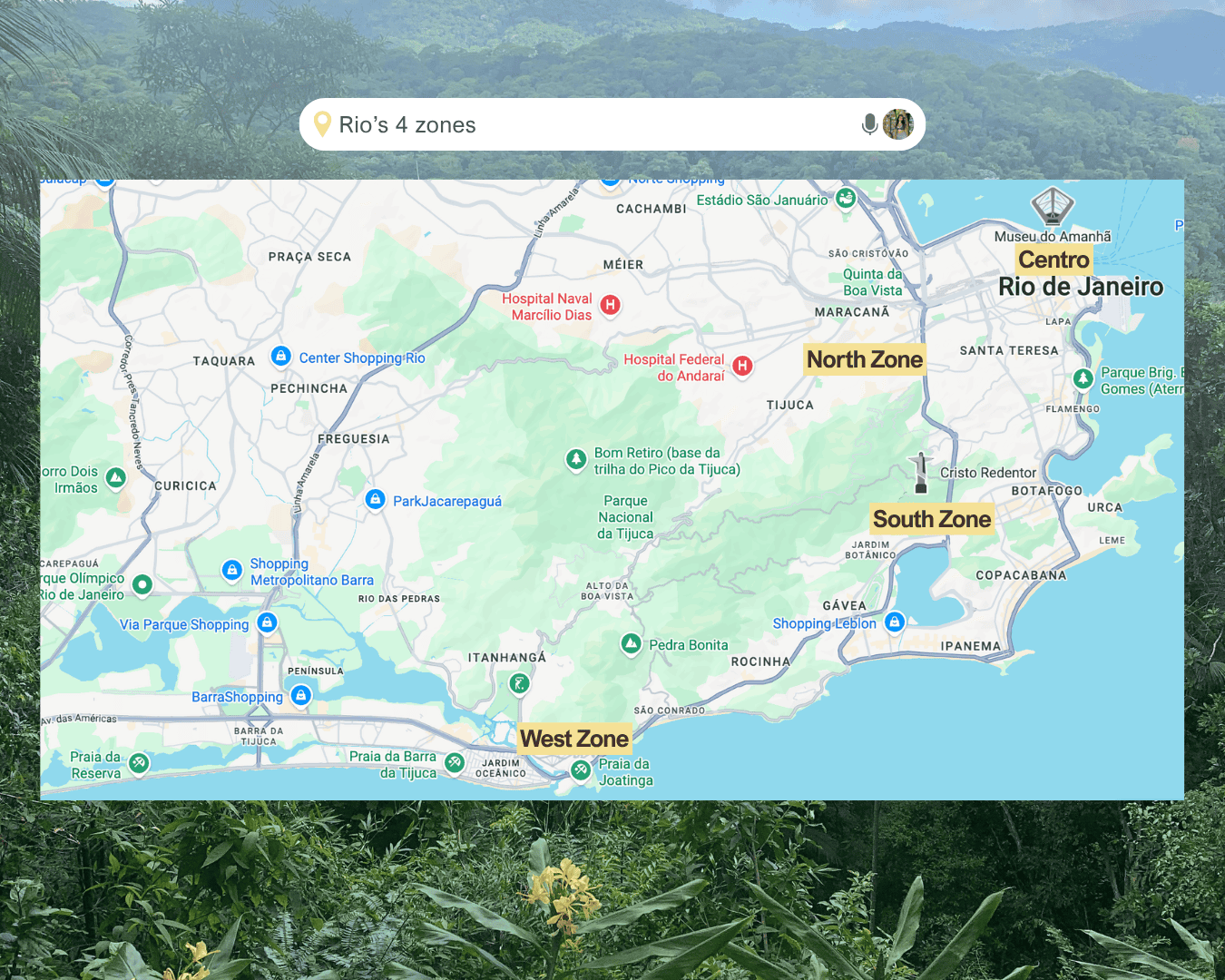
Zona Sul, or the South Zone
This is where you’ll most likely spend the bulk of your time in Rio. It’s home to the city’s most famous beaches, namely Copacabana, Ipanema, Leme, Leblon, (all of these are great neighborhoods to stay in, by the way!) Botafogo, Flamengo, and São Conrado, plus the iconic must-visit Sugarloaf Mountain.
For some reason, Santa Teresa, Rio’s bohemian neighborhood (and one of my favorite areas) is also technically in this zone. Although many people (myself included) consider it part of Centro, since it’s right behind that neighborhood, up in a hill.
Zona Oeste, or West Zone
This region includes Barra da Tijuca, which is one of the most underrated areas of Rio, in my opinion (such a great area to visit if you have a few extra days in Rio!)
I’ve visited a handful of times, and actually got married in this region, and I love how beautiful it is while also feeling more calm than other parts of the city. There are a lot of gorgeous and secluded beaches like Prainha Beach here too, plus, it also includes part of Floresta da Tijuca, of Tijuca Forest (which is giant, so it’s part of a few different zones), as well as Pedra Branca State Park.


Zona Norte, or North Zone
This is a much less touristy area, so you probably don’t have to worry about this one. But a couple notable spots include the Maracanã football stadium, part of Tijuca Forest, and Galeão Airport. There are also a bunch of samba schools in the area too, which are a really cool experience to visit.
🗺️ TIP: It’s important to note that the city is not laid out like a grid — so when you’re trying to get somewhere with public transportation, don’t think about the direction. Instead, look up the closest subway stop, and search for it on the Metro map, to figure out which line to take.
Public transportation in Rio de Janeiro
To be totally honest, I don’t use public transportation a ton in Rio. I’ve taken the subway a number of times when I’m with my husband, but in general, I find Ubering so affordable compared to in the U.S., that I just don’t feel compelled to use it a lot.
However, I have found it super useful particularly if you’re visiting Rio during its peak tourist season, or just trying to go somewhere during rush hour, when traffic can be really bad getting around the city.
The metro will also be really crowded at this time, which can be a tiny bit stressful, but coming from someone who is not savvy with public transportation, I think it’s all pretty straightforward.
Honestly, I’m determined to use it more on my future visits, since I really don’t have an excuse not to!
Here’s the rundown.


Using the Rio Metro System
The Rio metro system, Metrô Rio, is one of the most efficient forms of public transportation in Rio — and it’s surprisingly easy to use as a first-timer.
The Metro is considered very safe during the day. Just be sure to keep an eye on your things, and late at night, it’s better to just Uber (never walk if you’re alone at night, please!) (During rush hour, there is a woman-only car too, which is really cool.)
Living in LA, I can’t say I’m a public transportation expert by any means, but I’ve always found the Rio Metro to be pretty clean, and with clear signage throughout.
It operates with three lines (don’t ask me why it skips Line 3, lol):
- Line 1: from Ipanema-General Osório, in the South Zone, to Uruguai in the North Zone.
- Line 2: from Botafogo (South Zone) to Pavuna in the North Zone (including Maracanã football stadium on its route and with some overlap with Line 1)
- Line 4: from Ipanema-General Osório (South Zone) to the eastern side of Barra da Tijuca at Jardim Oceânico (the West Zone)
🎟️ One ride is $7.90 BRL.
You can buy a cartão pré-pago, or a prepaid card, named “Giro,” from any metro station, which can then be easily refilled. Some kiosks may be weird and be cash-only, but in general, you shouldn’t have an issue paying with a card.
The subway system has also recently gone through some revamping, and now, you can even just use your credit card to get through, without needing to buy a card.
As part of this overhaul, there’s also now an option for a prepaid card which also works for the bus, the Riocard mais.
However, this card can only be found at certain stations, unlike the Giro card, and I believe that it’s only available for residents — just letting you know so that you know what it is, if you see it offered!

Buses in Rio — Should You Use Them?
Buses run through Copacabana, Ipanema, Leblon and Barra da Tijuca, and typically cost around $5 BRL per ride. You’ll have to pay with cash, since the Riocard mais prepaid card, which can only be purchased at certain stations, and also works for the Metro, is only an option for locals.
With that said, the bus doesn’t have the safest reputation. I have personally never used them, and I’ve heard the same from multiple people who live in Rio. My husband, who’s a Rio local, literally just replied “avoid it” when I asked him what I should include for this guide so … there you have it.
If you are still determined to get around Rio by bus, however, just put your destination into Google Maps, and it will show you the bus route to follow. Moovit is another option that can occasionally be more accurate.
I do know that buses can be a good (and safe) option if you’re traveling a longer distance, like to São Paulo. In that case, you can use websites like BusBud to find routes — there are a few different companies that offer these longer distance routes.
Rio’s light rail system
I’ve never used this one either, since I’ve never really had a reason to. But known as the VLT, this above-ground rail operates in Downtown, or Centro, with 26 different stations. Definitely download the VLT Carioca app before using this — it’s a free app that has schedules and maps.
Although I can’t speak directly to it, I’ve heard that it’s pretty nice, and feels very modern.
It could definitely be super useful for museum-hopping in Downtown, if you’re trying to cover a lot of ground in a short time! It’s also connected to the Santos Dumont Airport, as well as the Novo Rio bus station, which could be helpful.
🎟️ One ride is R $5.


Biking in Rio with Bike Itaú
Biking can be a great way to get around, as there are lots of bike paths, especially around the beach.
Rio has its own bike-share system, Bike Itaú, with over 390 different bike stations around the city — just look out for the bright orange bikes.
You’ll have to download the Bike Itaú app, which asks for either a CPF (essentially a Brazilian ID number, which foreigners can apply for) or your passport info. (This is a huge improvement, because in the past you needed a CPF, which was super annoying. I needed to use one of my husband’s friend’s accounts, which is just not practical, especially if you don’t know anyone in Rio yet.)
From there, there are different plans available that you can purchase, whether you’re looking for one-time use or longer.
Allegedly, you can also rent bikes using the Uber app, but I haven’t tried this myself!

Taxis vs. Uber in Rio: Which Is Safer and Cheaper?
While taxis in Rio often overcharge tourists, Uber in Rio de Janeiro is more transparent and generally safer, which is something you have to keep in mind in Rio, especially at night.
Just remember to always check the license plate before you get into a car. When I’m alone in Rio, I always share my ride with my husband so he can keep an eye on my route.
Uber prices are ridiculous nowadays in the U.S., so I find it super affordable in Rio, comparatively.
Pretty much all of my Uber rides on my most recent visit were from $10 BRL to $30 BRL — my most expensive was $65 BRL, which is less than $12 USD at the time of writing.
💰If you’re budgeting your trip, check out my Brazil budget guide where I break down costs in way more detail.
One thing to keep in mind though is that on my most recent trip, I did find it slightly harder to get a ride than I remembered.
Sometimes it took several minutes or even longer before a driver would accept my ride, and they’d occasionally cancel, or leave if you’re not standing outside as soon as they arrive. I’m not sure what’s changed over the past couple of years, but it is something to be aware of.


Driving in Rio de Janeiro: Should You Rent a Car?
To be totally honest, I would not suggest doing this.
I think if you’re not used to driving here, it’s extremely difficult and unsafe. I will stop myself from going on a tangent, but long story short, drivers can be super aggressive, traffic is horrible, and roads are hilly and often with poor conditions.
Plus, navigating is not easy by car, and you don’t want to end up in dangerous areas accidentally. Not to mention that parking can be super stressful!
Since it’s such a big city that’s well-connected by the Metro, and with Uber easily accessible, I also just don’t think driving yourself would even be particularly helpful.
The only reason where I think it may make sense would be if you’re looking to explore more of Brazil. For instance, during one visit, my husband and I planned a trip to Paraty, which is four hours away from Rio by car. Driving ultimately saved us a couple of extra hours on the bus. São Paulo is around a five or six-hour drive too.
In this case, there are a handful of rental car companies available. Just make sure to look into local driving regulations ahead of time, and please get insurance!


Final Tips for Getting Around Rio Safely Like a Local
Especially if you’re traveling solo, getting around can be daunting, I know, but I hope this Rio de Janeiro transportation guide has made things clearer for you.
Although Rio is a big city, I feel like it’s well-connected, and fairly easy to navigate, once you get a hang of the layout and neighborhoods. And that’s coming from someone who manages to get lost in my own city — so trust me when I say you’ll be ok!
Just make sure you have a working SIM card, so you can easily call Ubers, check maps, and get help if needed, please! Especially if you’re traveling solo, this is 100% a must.
During my first solo international trip to Chile and Argentina, I would literally have to screenshot directions before I left my hostel, which obviously did me no good when I got lost! (Check out this guide for the one I recommend, plus a discount code to try it out!)
Everything I’ve learned over my past few years of visiting Rio can be found in my ebook, “A Cultural Guide to Rio de Janeiro.”
It’s filled with ways to experience the different sides of local culture, from its music and history to its art and football. Plus, it has all the logistical details you need to plan a smooth trip and have a grasp of the city’s culture and language before you land!

Head to one of these Rio guides next
- Best Time to Visit Rio de Janeiro (Seasonal Guide)
- How to Get Around Rio de Janeiro Like a Local
- Where to Stay in Rio de Janeiro on a Budget
- Windsor Leme Hotel Review: Perfect for First-Time Rio Visitors
- One Week in Rio de Janeiro Itinerary
- 6 Best Museums to Visit in Rio de Janeiro
- Best Weekend and Day Trips from Rio de Janeiro
- Best Rio de Janeiro Restaurants: Botecos, Samba & More
- 15 Brazilian Foods and Drinks You Have to Try in Rio de Janeiro
- How to Pack for Rio de Janeiro, Brazil
- How to Get to Sugarloaf Mountain, Rio de Janeiro
- The Ultimate Rio de Janeiro Travel Guide
- Is Rio de Janeiro Safe? My Honest Thoughts After 6 Visits
- Is Brazil Expensive to Visit? A Budget Breakdown
- 5 Best Places to Visit in Brazil for Your First Trip
