3 Days in Salvador, Brazil Itinerary
Disclosure: Tess the Traveler contains affiliate links and is a member of the Amazon Associates Program, meaning that if you make a purchase using one of these links, I may earn a commission. I only recommend products and companies I trust. See the Privacy Policy for more information. Thanks for your support!
Thinking about visiting Salvador but only have a few days to explore? Don’t worry — 3 days in Salvador, Brazil is just enough to experience the city’s rich Afro-Brazilian culture, historic charm, and some of the best beaches in Bahia.
I spent a few days in Salvador during a three-week solo trip through Brazil, and instantly fell in love with its magnetic atmosphere. Between popping into colorful shops, enjoying some gorgeous views of the Bay of All Saints, and searching for the perfect moqueca, even a short stay in Salvador is enough to make you fall in love with its one-of-a-kind energy.
This 3-day Salvador itinerary will walk you through the can’t-miss highlights — from the cobblestoned streets of Pelourinho to the beautiful beaches of Barra and the bohemian nightlife of Rio Vermelho — so you can make the most of your time without feeling rushed. Food was also a huge highlight of my time here, and there are also so many amazing places to eat in Salvador, so I’ve made sure to include a few recommendations for each neighborhood too.

Day 1 in Pelourinho: Salvador’s historic center
Morning
In many ways, Pelourinho feels like the heart and soul of Salvador. Of my few days in Salvador, I can swear that most of my time was just spent wandering around here.
So, it’s only fitting that this is where you kick off your Bahia travel itinerary!
The whole neighborhood is a World Heritage Site, and it’s so beautiful, with its cobblestone roads and colorful, colonial-style buildings filled with art galleries, shops, and cultural institutions.
Throughout the neighborhood, you’ll see Baiana women in their wide-hooped white dresses, vendors selling delicious street food like acaraje (black eyed pea fritters stuffed with shrimp), and street performers playing the drums or capoeira, a Brazilian dance and martial art that was created as a form of resistance during the times of slavery.
If it looks familiar, it was also the backdrop of the iconic Michael Jackson music video, “They Don’t Care About Us,” which you may have seen.
💌 This Pelourinho walking tour has lots of great ratings and is just an hour and a half, which works perfectly for a quick three days in Salvador. Book here to experience Salvador with a local! 🎨
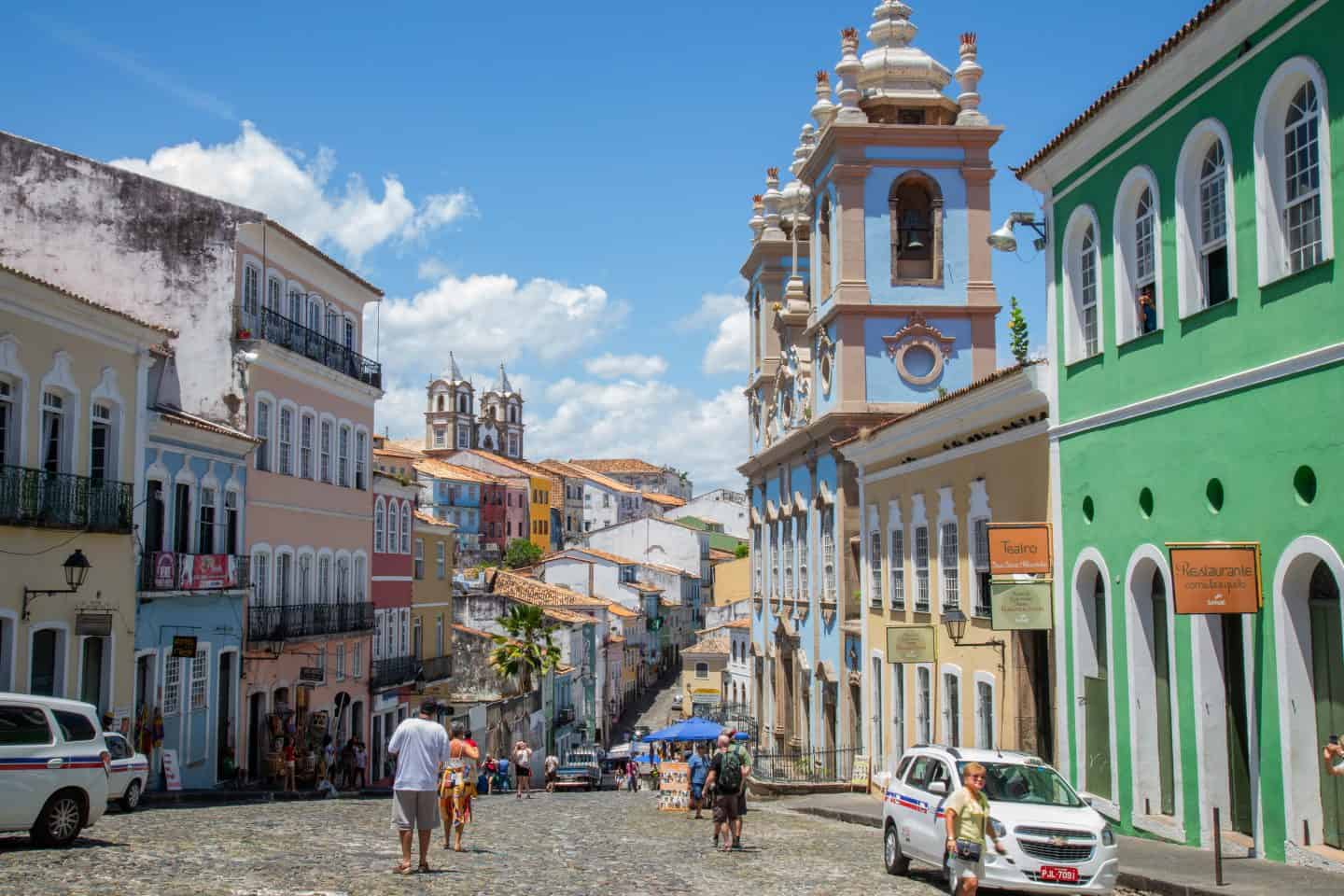
Check out the neighborhood’s beautiful churches, Igreja de São Francisco and Catedral Basílica, which you can admire from outside like I did (or pay ~R$5 if you want to go in), and wander around the main square, Praça da Sé.
If you’re looking for some specific sightseeing, stop by the Afro-Brazilian History Museum (~R$10), which gives important context to Salvador’s roots, and Casa do Carnaval (~R$30), where you can learn about the history of Carnival in Salvador and even join a virtual bloco parade.
If you didn’t know, Salvador is actually one of Brazil’s biggest Carnival celebrations along with Rio de Janeiro. A lot of Brazil’s Carnival’s traditions actually trace back to Afro-Brazilian culture in Salvador.


Where to Eat in Pelourinho
There are lots of food options around Pelourinho, so either have lunch at one of the restaurants, or go for street food if you’re sticking to a lower budget on your Brazil trip. Here are some places to try:
- Odoyá — I’ll be honest, I think I ate moqueca (a seafood stew) or bobó de camarão (a thick shrimp stew made with pureed cassava) every day I was here. So while I’m sure there’s a lot of dispute around where you can find “the best,” Odoyá is arguably one of the top moqueca spots in Pelourinho.
- Boteco do Pelourinho — A boteco or “root bar” is an iconic Brazilian experience — don’t expect the fanciest food or service here, but rather an ice cold beer with a community-based vibe. Relax at one of the outdoor tables with Pelourinho’s beautiful scenery all around you, and try some local Bahian dishes.
- Cuco Bistrô — One of Salvador’s most popular restaurants, come here for regional cuisine in an elegant setting, complete with art by local artists, vegan and vegetarian options, and one of the best cachaça menus in town.
🥥 My Quick Salvador Planning Tips 🌴
🌞 The homiest and most luxurious place to stay in Salvador (perfect location, plus breakfast!)
🎨 Short on time? This customizable day tour shows you the best of Salvador in a few hours
🌎My go-to travel insurance for Brazil
📱My favorite eSIM (I even had service on a remote Brazilian island — use code TESS5 for 5% off!)
🧳 At the top of my packing list: A secure bag, a phone wrist strap, and swimwear

Afternoon
Salvador’s historic center is divided by two levels: the upper level and the lower level (For context, Pelourinho is on the upper level, or “cidade alta”). And while you can just Uber between the two, Salvador actually has a really unique landmark that makes the transport super easy.
Elevador Lacerda is a historic elevator that’s been around since 1873, and part of what makes it cool is that it’s 236 feet tall, giving you a really incredible view of the bay.
It’s super quick — just 30 seconds or so — so don’t get your expectations too high here.
I was dumb and didn’t do my research before visiting, so after walking all the way to the top viewpoint, I Ubered to the entrance at the bottom, and then took the ride, only to end up right where I started. Ah, the joys of solo travel.
But, on the bright side, it costs just a few cents — R$0.15 — making it a non-negotiable during your Salvador vacation, just to have the experience!
Elevador Lacerda runs daily until 10 or 11 p.m.
Right by the entrance on the lower level, make sure you also stop at Mercado Modelo. You’ll find lots of affordable souvenirs and local crafts, and it’s a great people-watching spot even if you’re not looking to shop.
Not all of it will be great quality though — I bought a cute evil eye keychain, a necklace, and some earrings here — the keychain and necklace both broke within a couple of months, and the earrings irritated my ears so I only wore them once. I guess the old adage “you get what you pay for” does ring true sometimes.
Still, it’s one of the city’s landmarks, and I’m sure you can end up having better luck than me!
Most vendors will accept credit cards, but it’s not a bad idea to have some cash on hand. Some places may even offer you a discount for paying with cash.

Evening
Next, head to Museu de Arte Moderna, which is just around half a mile away (but you’ll still want to take an Uber as it’s not a really walkable route and the area around the museum is known for muggings).
Located right on the Bay of All Saints, this museum is free to visit and has rotating exhibitions. It’s pretty small so it’ll just take you 20 or 30 minutes to peruse, if that.
It’s allegedly open until 6 every day except Mondays when it’s closed — but those hours can also be unreliable. I tried visiting once and found that it was closed, so I came back another day, because I guess I was feeling really determined. (As I’m writing this, it’s dawning on me just how many mishaps I had throughout my time in Salvador 😂)
But regardless of whether the museum is open or not, the real reason you don’t want to skip this is right outside the museum.
The museum is located within the Solar do Unhão complex, which dates back to the 1700s and is also one of the best sunset spots in the city.
I sat at Praia da Gamboa, the little beach that’s right here for at least an hour and watched the sunset, and maybe this is kind of lame, but it’s honestly one of my favorite solo travel memories.
If you’ll be in Salvador on a Saturday, this would also be a great time to come here, since this is when there are jazz and bossa nova concerts, known as JAM no MAM.
When you’re ready for dinner, head back to Pelourinho, or to its neighboring neighborhood, Santo Antônio. It’s also a historic neighborhood with lots of charm, but is slightly less touristy than the more famous Pelourinho.

Where to eat in Santo Antônio
- Bar do Ulisses — this bar has been around for 60 years and is loved for its crispy fried fish, ice cold beer, caipirinhas, and view, which is extra special at sunset.
- Poró — another one of the neighborhood’s most famous spots. Its brownie topped with caramelized popcorn is supposedly amazing. Sit on the patio for great views of the bay, while shielded by colorful umbrellas. Inside, you’ll find an art gallery.
- Zanzibar — the spot for a menu and ambiance that spans across Brazil and Africa. The restaurant is decorated beautifully, and the menu includes mouth-watering dishes like Ebubu-fulô, fish with ginger sauce and mashed plantain, and fried fish bites with a mango salad and pineapple sauce.
Day 2 in Barra: Salvador’s best beach
Morning
Start off your day at the Museu de Arte da Bahia, the oldest museum in the state of Bahia. If you like art and history, then you have to make time for this during your visit to Salvador.
I honestly loved this museum. It has a pretty diverse collection, and you’ll see lots of work by local artists along with some European and other South American art, and a mix of classic and more contemporary work. There are also a lot of artifacts and items from the colonial era, which was really interesting to see.
Museu de Arte da Bahia isn’t huge, but I spent around an hour or so here, taking my time in the various rooms. It’s located in a historic mansion, so the space is also just really pretty.
Admission is free!

Afternoon
Although you got a little taste of Salvador’s beaches last night at Solar do Unhão, the best beaches in Salvador are actually in the Barra neighborhood, which is less than a mile away from Museu de Arte da Bahia.
Around Barra, you’ll find no shortage of food options, so grab some lunch here.
Then before hitting the beach, make a quick sightseeing stop at Farol da Barra, a famous lighthouse and fort. I’ll be honest — like I said, I was feeling super lazy by the time I got to Salvador, so I skipped this, but I’m really regretting it. It’s one of the main symbols of Salvador, and it also has so much history, which is something I generally like to prioritize when I travel.
The lighthouse had even been recommended to me by other travelers too, on top of just being one of the “best things to do in Salvador, Brazil” that all the guidebooks recommend. So don’t be like me and go!
The fort, which is officially called Forte de Santo Antônio da Barra, dates back to 1698 and is actually the oldest in South America.
Nowadays, it’s known for its incredible view, as well as for housing the Museu Náutico da Bahia (~R$20), which gives a look into maritime history and the darker aspects of Salvador’s history, i.e. colonization and slavery. The museum is open daily from 9 a.m. to 6 p.m.
Afterwards, stroll to Porto da Barra Beach, one of Salvador’s best beaches, and hang out here as long as you want.
Porto da Barra Beach is known for its warm, calm waters, and it’s also an amazing sunset spot (as you may have noticed at Solar do Unhão, many Brazilians will even clap when the sun goes down at the beach).
☀️ Porto da Barra Beach tip: Umbrellas and chairs are available to rent, and you can also easily buy drinks or snacks. But vendors here are known for overcharging, so be sure to ask the price before agreeing to anything, and negotiating if it seems unreasonably high.
If you don’t feel like hanging around the beach that long, you can take a 20-minute Uber ride to Feira de São Joaquim, the largest open-air market in Salvador. Here, you’ll find tons of affordable street food, Afro-Brazilian spiritual items (African Brazilian religions are huge in Salvador, and it’s a huge part of the culture, even for people who aren’t part of these religions), and crafts.


Where to eat in Barra
- Sertão e Mar — Technically in the Ondina neighborhood right next to Barra, this spot serves local Bahian dishes in a cozy atmosphere.
- Mirante Forte São Diogo — Located at the 16th century São Diogo Fort, this restaurant faces the beach and serves everything from burgers to steaks to lots of seafood dishes.
- Recôncavo Culinária — Another amazing spot for Brazilian cuisine, like maniçoba (a festival dish from the Pará region that’s made slow-cooked cassava leaves and salted and smoked meats), various seafood stews, and feijoada, a bean and meat stew that’s considered Brazil’s national dish. It’s not the cheapest, but portions are generous!
Day 3 in Rio Vermelho: Salvador’s bohemian neighborhood
Morning
During my time here, I made so many mistakes — and one of those things was not exploring enough of the best neighborhoods in Salvador. But if I could do it all over again, I’d spend more time in the Rio Vermelho neighborhood, following the itinerary I’m sharing with you bnow.
This area’s biggest claim to fame is its nightlife scene, but it’s honestly so much more than that. It’s considered a bohemian neighborhood and a cultural hub, and was and is home to a number of major Brazilian artists and musicians like Gal Costa (who was part of the tropicália movement, which blends samba, bossa nova, and rock) and Gilberto Gil (a legendary singer, activist, and politician)
To start off your time here, head to Casa do Rio Vermelho, the former home of one of the best-known modern Brazilian writers, Jorge Amado. I have yet to read any of his books, but he was nominated seven different times for the Nobel Prize in Literature, and his life even included years of political exile from Brazil for his associations with communism.
I love visiting the homes of artists (like Frida Kahlo’s home in Mexico City and Pablo Neruda’s seaside Valparaiso, Chile house), so I seriously wish I’d known about this when I visited Salvador.
As the home of Amado and his wife Zélia Gatai for 40 years, it was supposedly the spot where he wrote a number of his books, while also serving as a meeting point for numerous artists and activities including Pablo Neruda and Simone de Beauvoir.
Tickets are R$20, or free on Wednesdays, and its open from Tuesdays through Sundays from 9 a.m. to 5 p.m. Plan to spend an hour or two — I’ve also heard that English information is kind of limited, so be sure to download Google Translate beforehand so you can easily translate any exhibit info.

Afternoon
For lunch, head to Ceasinha do Rio Vermelho Market to find some budget-friendly food. Apart from lots of vendors selling all kinds of produce, seafood, and more, there are also a number of cafes and simple restaurants perfect for a quick meal or some people-watching.
Afterwards, another Rio Vermelho must-see is Casa de Iemanjá at Rio Vermelho Beach. As I briefly mentioned earlier, Afro-Brazilian religions have played a huge role in shaping local culture, and this is one of the best ways to see a bit of it for yourself.
Dedicated to Iemanjá, an orixás or deity that rules over the sea, motherhood, and the home, it’s essentially a small temple and sanctuary overlooking the sea. If you’re visiting in early February, you may even catch the festival dedicated to her, when thousands gather at the beach by Casa de Iemanjá to give an offering. Afterwards, it becomes a huge street party, full of music and celebrations.
Casa de Iemanjá is free to visit.
For the rest of the afternoon, I’d suggest hanging out at the beach — Buracão Beach is another one of the best beaches in Salvador, and is just around a mile away from the temple. Or, head back to Pelourinho to check out any sightseeing that you missed on day one.

Where to eat in Rio Vermelho
- Pasta em Casa — If you’re in the mood for Italian, this is one of the best choices in Salvador for pizzas and pasta. Just don’t come here if you’re in a rush — service is known for being on the slower side here.
- Jabú Resto & Bar — another one of the best-known restaurants in the area, Jabú fuses local ingredients with French cuisine and techniques, making for one of the most inventive and beloved menus in Salvador. Also come here for great ambiance and cocktails!
- Restaurante Manga — This restaurant has been rated as one of the best restaurants in the world, thanks to its inventive menu. It’s definitely one of the priciest dining spots you’ll find in Salvador, but worth it for a splurge. Plus, you get another incredible ocean view.
Evening/Night
Rio Vermelho is known especially for nightlife — but even if you’re not the partying type, at the very least, check out some live music while you’re here. Music is a huge part of Brazilian and Bahian culture, so don’t skip out on experiencing some of it!
Nightlife in Rio Vermelho
Some places to get you started:
- San Sebastian — come here to hear everything from samba to axé, to funk, and Brazilian popular music, and more.
- Borracharia – One of the area’s most popular spots for nightlife that is actually a tire shop during the day. It has a quirky and cool vibe and music ranges from rock to samba.
- Casa da Mãe — a popular bar and live music venue that’s also a cultural center.

Where to Stay in Salvador
I stayed in the Pelourinho neighborhood, and loved having such easy access to sightseeing, history, culture, and lots of great food.
Ubers are easily accessible in Salvador, so it was no problem just calling one when I wanted to get to a different area of the city. If you want to maximize your beach time, Barra would be another beautiful area, and is probably where I’d stay if I (hopefully!) get to return.
Get all my top picks in this neighborhood and budget stay guide.
Planning your Brazil trip
Salvador is such a culturally rich, beautiful, and one-of-a kind city — everyone who visits seems to fall in love with it, and I feel pretty confident that you’ll feel the same!
To keep planning your trip through Salvador and Brazil, head to one of these guides next:
- How to Visit Salvador, Brazil: A Complete Guide
- Best Places to Stay in Salvador, Brazil: Budget Guide
- Is Salvador, Brazil Safe? A Solo Traveler’s Honest Take
- Is Brazil Expensive to Visit? A Budget Breakdown
- 5 Best Places to Visit in Brazil for Your First Trip
- Three Weeks in Brazil Itinerary
- Best Things to Do in Recife, Brazil: Beaches, Food & History
- Top Things to Do in Porto de Galinhas, Brazil
- 15 Best Things to Do in Sao Paulo, Brazil
- One Week in Rio de Janeiro Itinerary
